
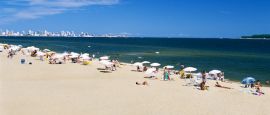


Surrounded by immense dunes and reached by authorised four-wheel-drive trucks, Cabo Polonio feels far removed from Uruguay's developed coastal resorts. Simple houses spread around a rocky headland dominated by a lighthouse, with wide beaches extending in both directions. Offshore rocks support a large colony of sea lions that can be viewed from the surrounding paths.
Book and Go

Latest features
Uruguay things to see and do
Cabo Polonio
Canelones wine region
The vineyards surrounding Montevideo extend into Canelones, the centre of Uruguay's wine industry. Family-run wineries specialise in Tannat, the country's signature red grape, alongside varieties including Albariño, Merlot and Cabernet Franc. Many estates offer cellar tours, guided tastings and lunches paired with local wines.
Casapueblo
Casapueblo rises above the sea at Punta Ballena as a maze of white terraces, curving walls and irregular towers. Uruguayan artist Carlos Páez Vilaró built the complex gradually over several decades, drawing inspiration from Mediterranean villages and the mud nests of native hornero birds. It now contains a museum, gallery and hotel and is particularly atmospheric at sunset.
Colonia del Sacramento
Cobbled lanes, bougainvillea-covered houses and weathered stone walls give Colonia del Sacramento its distinctive character. Founded by the Portuguese in 1680, the city has a UNESCO-listed historic quarter that reflects both Portuguese and Spanish rule. Visitors can climb the lighthouse, explore small museums and watch the sunset across the Río de la Plata.
Esteros de Farrapos e Islas del Río Uruguay National Park
Wetlands, river channels and wooded islands form an important wildlife habitat along the Uruguay River near San Javier and Nuevo Berlín. The park shelters capybaras, otters and numerous waterbirds, while boat trips and guided excursions provide access to otherwise isolated areas. Seasonal flooding continually reshapes this peaceful landscape.
Fray Bentos Industrial Landscape
This UNESCO World Heritage Site preserves the vast riverside complex where Liebig meat extract (associated with the OXO brand) and Fray Bentos corned beef were produced for export around the world. Warehouses, machinery, laboratories and workers' buildings reveal how livestock from Uruguay's grasslands was processed on an industrial scale. The on-site Museum of the Industrial Revolution explains the history of the former Liebig and Anglo factories.
Montevideo
Uruguay's capital combines historic architecture, neighbourhood markets and a long waterfront promenade. Ciudad Vieja contains Teatro Solís, the Metropolitan Cathedral and the cafés and galleries around Plaza Matriz, while the Mercado del Puerto is known for its traditional grills. The 22km Rambla follows the Río de la Plata past beaches, parks and residential neighbourhoods.
Nueva Helvecia
Known locally as Colonia Suiza, Nueva Helvecia was founded in 1862 by immigrants principally from Switzerland. Swiss cantonal shields decorate many houses and public buildings, while the settlement's heritage survives through traditional festivals, family names and a strong dairy and cheese-making culture. Visitors can explore the quiet town centre and sample cheeses produced on surrounding farms.
Piriápolis
Piriápolis retains the gracious atmosphere of an early-20th-century seaside resort, with a broad waterfront promenade backed by wooded hills. A chairlift climbs Cerro San Antonio for views across the coast, while Cerro del Toro has walking trails and a fountain shaped like a bull. The hilltop Castillo de Piria recalls the ambitions of the resort's founder, Francisco Piria.
Punta del Diablo, Santa Teresa National Park
Punta del Diablo developed from a small fishing settlement into a relaxed beach destination known for surfing, seafood and colourful houses overlooking the Atlantic. Just north, Santa Teresa National Park protects beaches, coastal forest and walking trails. Its centrepiece is Fortaleza de Santa Teresa, an imposing 18th-century fortress built during disputes between the Spanish and Portuguese empires.
Punta del Este
Uruguay's best-known seaside resort lies between the sheltered waters of Playa Mansa and the Atlantic waves of Playa Brava. Its marina, restaurants and nightlife attract large summer crowds, while La Mano, a giant hand emerging from the sand, has become the city's defining landmark. Boat trips depart for Isla Gorriti and the sea-lion colony around Isla de Lobos.
Quebrada de los Cuervos
This dramatic ravine cuts through the rolling hills of Treinta y Tres in eastern Uruguay. Walking trails descend through native woodland towards the Yerbal Chico stream, passing rocky viewpoints and subtropical vegetation. The name means "Ravine of the Crows", although the large dark birds commonly seen circling overhead are black vultures.
Salto, Daymán and Arapey hot springs
The countryside around Salto contains naturally heated groundwater used by several thermal resorts. Daymán combines public pools, spa hotels and a family water park, while Arapey has a quieter setting beside the Río Arapey. Pool temperatures vary across complexes, making the region suitable for visits year-round.
Do you have any Feedback about this page?
© 2026 Columbus Travel Media Ltd. All rights reserved. No part of this site may be reproduced without our written permission, click here for information on Columbus Content Solutions.



 You know where