



Coffee tourism is popular in Costa Rica, particularly in the Heredia, Alajuela, Tarrazú and Monteverde regions, where volcanic soils and cooler temperatures create ideal conditions for growing high-quality Arabica coffee. Many plantations offer guided tours explaining the cultivation, harvesting and roasting process, often combined with tastings and views over coffee-covered hillsides.
Book and Go

Latest features
Costa Rica things to see and do
Coffee Tourism
Arenal Volcano and La Fortuna
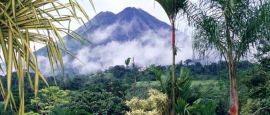
Arenal Volcano, with its near-symmetrical cone rising above rainforest and farmland, is one of Costa Rica's most recognisable landmarks. The surrounding town of La Fortuna serves as the base for hot springs, waterfalls, hanging bridges, wildlife tours and outdoor activities including zip-lining and rafting. Although volcanic activity has declined significantly since its dramatic eruptive period in the late 20th century, the landscape remains one of the country's defining sights.
Corcovado National Park and the Osa Peninsula
Corcovado National Park protects one of the last large areas of lowland Pacific rainforest in Central America. Located on the remote Osa Peninsula, it supports extraordinary biodiversity including tapirs, scarlet macaws, four monkey species and, occasionally, jaguars. Access usually involves a combination of boat travel, guided hiking and eco-lodge stays, giving the region a more adventurous character than many other parts of Costa Rica.
Irazú Volcano National Park
Irazú Volcano, the highest active volcano in Costa Rica, rises above the Central Valley east of San José. On clear days, visitors may see both the Pacific Ocean and the Caribbean Sea from the summit region. The stark volcanic landscape and green crater lake create a dramatic contrast to the surrounding farmland and forest.
Manuel Antonio National Park
Despite being one of Costa Rica's smallest national parks, Manuel Antonio combines rainforest, wildlife and beaches in an unusually accessible setting. Trails pass through forest inhabited by monkeys, sloths and iguanas before emerging onto white-sand beaches backed by jungle-covered hills. Its proximity to San José has made it one of the country's most visited protected areas.
Monteverde Cloud Forest Reserve
Monteverde's cloud forests are among Costa Rica's most celebrated natural environments. Mist drifts through dense forest canopy filled with orchids, mosses and epiphytes, while suspended bridges and trails provide access to remarkable biodiversity. The reserve is particularly well known for birdlife, including the resplendent quetzal, one of Central America's most sought-after species.
Montezuma and Santa Teresa
These neighbouring beach communities on the southern Nicoya Peninsula attract surfers, backpackers and long-stay visitors seeking a more laid-back atmosphere. Montezuma combines beaches with waterfalls and forest trails, while Santa Teresa has evolved into one of Costa Rica's best-known surf towns with cafés, yoga studios and boutique accommodation spread along the coast.
Nicoya Peninsula
The Nicoya Peninsula contains some of Costa Rica's best-known beach and surf destinations, including Santa Teresa, Montezuma, Nosara and Sámara. Parts of the peninsula remain relatively undeveloped, with rough roads and quieter beaches contributing to its appeal. The region has also become associated with yoga retreats, wellness tourism and surfing culture.
Poás Volcano National Park
Poás Volcano contains one of the world's largest active volcanic craters, with steaming fumaroles and a striking acidic crater lake. Located within easy reach of San José, it is one of the country's most accessible volcanoes. Weather conditions can change rapidly, and clouds often obscure the crater later in the day.
Puerto Viejo de Talamanca and Cahuita
The Caribbean coast around Puerto Viejo and Cahuita has a distinctly different atmosphere from the Pacific side of Costa Rica. Afro-Caribbean culture strongly influences the region's food, music and architecture, while nearby Cahuita National Park combines coral reefs, beaches and coastal rainforest. The pace of life here is notably relaxed.
Rafting and river adventures
The country's steep volcanic terrain and heavy rainfall create ideal conditions for white-water rafting. The Pacuare River is widely regarded as one of the world's great rafting rivers, combining rapids with rainforest scenery and abundant wildlife. Other popular rafting rivers include the Reventazón, Sarapiquí and Savegre.
Rincón de la Vieja National Park
This volcanic national park in Guanacaste combines dry tropical forest with geothermal activity including bubbling mud pools, hot springs and steam vents. Hiking trails pass through waterfalls, volcanic landscapes, and forests inhabited by monkeys and coatis. The surrounding region is also popular for horseback riding, tubing and adventure activities.
Rio Celeste and Tenorio Volcano National Park
Rio Celeste is famous for its striking turquoise-blue water, created by a natural chemical reaction between volcanic minerals. Trails through Tenorio Volcano National Park lead to waterfalls, thermal springs and rainforest viewpoints. The river's colour is particularly vivid during periods of dry weather.
San José
Costa Rica's capital is often overlooked by travellers heading directly to the beaches or rainforest, but it contains several worthwhile museums and historic districts. The Pre-Columbian Gold Museum and Jade Museum provide insight into the region's Indigenous cultures, while neighbourhoods such as Barrio Escalante and Barrio Amón have developed lively café, restaurant and nightlife scenes.
Surfing
Costa Rica is one of the leading surfing destinations in the Americas, with breaks suitable for everyone from beginners to experienced surfers. The Pacific coast is particularly important, with Tamarindo, Santa Teresa, Dominical and Pavones among the best-known locations. The Caribbean coast around Puerto Viejo also produces powerful seasonal waves, especially at Salsa Brava, considered one of the most challenging breaks in the region.
Tortuguero National Park
Tortuguero is a network of rainforest canals, rivers and lagoons on Costa Rica's Caribbean coast, accessible mainly by boat or small aircraft. The park is internationally important as a nesting site for green sea turtles, which come ashore between July and October. Wildlife viewing by boat is a central part of the experience, with sightings often including caimans, monkeys, toucans and sloths.
Do you have any Feedback about this page?
© 2026 Columbus Travel Media Ltd. All rights reserved. No part of this site may be reproduced without our written permission, click here for information on Columbus Content Solutions.



 You know where
